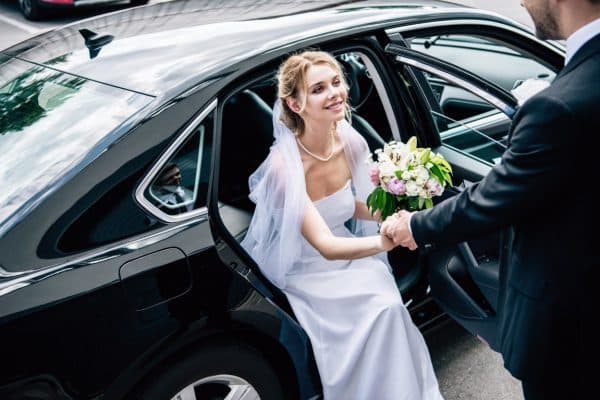
Most Philadelphia weddings need two to three vehicles. One for the couple, one for the wedding party. A third is needed when the ceremony and reception are at separate locations, or when out-of-town guests need a confirmed transfer from their hotel.
That said, the number changes fast once you map out the actual day.
Start With the Itinerary, Not the Guest Count
The biggest mistake couples make is counting heads and stopping there. Eight bridesmaids and groomsmen sound like they would fit in one vehicle. Eight people in formal attire, with full-length dresses and suit bags, is a different calculation. What we commonly see is couples who book two vehicles and end up needing three once they map out the getting-ready location, the ceremony, the photo stops, and the reception.
Philadelphia weddings frequently split across locations. A ceremony at a church in Old City and a reception at the Crystal Tea Room are manageable. A ceremony at the Barnes Foundation, photos at City Hall, and a reception at the Ritz-Carlton require a mapped itinerary across multiple departure points. Additional stops mean additional vehicles, or additional waiting time factored into a single vehicle’s day.
Do You Have to Provide Transportation for Wedding Guests?
No. Most guests drive themselves or sort out their own way there. But two situations make guest transportation worth considering.
The first is parking. Venues in Center City and Fishtown on a Saturday have limited and expensive parking. Guests who know a shuttle is running arrive relaxed and are far more willing to have a drink at the reception.
The second is distance. Suburban venues draw guests from across the region. Having a large vehicle running from a nearby hotel removes the question of who is driving home at the end of the night.
How to Pick Wedding Transportation?
Match the vehicle to the group, not to what photographs well.
The couple typically goes in a sedan. It fits two people with a full-length dress, a suit bag, and room to breathe. A mid-size SUV works when the couple wants to bring a small group or needs extra space for the dress.
The wedding party needs honest math on group size and dress volume. Six to eight people fit in a large SUV. Ten or more are better served by a Sprinter, which also holds the group together rather than splitting across two vehicles.
When picking wedding transportation, the most critical factor after vehicle size is venue knowledge. A company that knows the arrival windows at the Four Seasons, how curbside drop-off works at Front & Palmer, or what the loading situation looks like at Knowlton Mansion runs the day differently than one figuring it out on arrival.
How Much Is Wedding Transportation?
Wedding transportation costs vary based on how many vehicles you book, how many hours each is in service, and whether the itinerary involves multiple stops or waiting time between events. The total reflects the full day, not a single trip.
Map out the full day first, then request a quote. The number of hours matters as much as the fleet size.
Good to Know
How far in advance should I book wedding transportation?
Six to twelve months out is standard, particularly for Saturday dates between April and December. Sprinters and larger SUVs confirm early. If your date is within three months, it is worth calling. Availability does open up.
What happens if the ceremony runs long?
Chauffeurs remain on location and in direct contact with the couple or wedding coordinator. If things run long, the vehicles are already there and the itinerary adjusts in real time.
Do I need separate vehicles for the couple and the wedding party?
Most couples book separately for the arrival. It makes logistics cleaner and gives the two of them a private moment between the getting-ready location and the church. After the reception, most combine into one vehicle for the send-off.